Wednesday, April 10, 2013

1911 T205 WILLIAM BERGEN SGC 50


Through the years, I've acquired somewhere north of 150 graded “vintage” Mets cards.

But recently, the thrill of the chase has gone cold. I cannot muster much enthusiasm in the service of tracking down a nice copy of a 1968 Dick Kenworthy or others of its ilk.

Sure, I find some stray excitement in scoring hard-to-find oddball/test issues, but even then the rush is relatively unleaded.

So it has become clear to me that a change in collecting priorities is in order. And I think I've located the perfect fix: pre-war cards (that is, anything issued in 1941 or years prior).

More specifically, I've decided to focus on pre-war cards of Brooklyn players.

(I needed a way to constrain my goals, and limiting myself to Brooklynites has the added advantage of being budget-friendly, because, well, let's just say that the pre-war Brooklyn squads were not littered with Hall of Famers.)

This 1911 T205 William Bergen was my first purchase, and it was a decision based largely on aesthetics. The gold-bordered T205 issue is a beautiful set, and I'd argue that the Brooklyn cards, with their deep blue colors and unfussy design, are particularly attractive.

You'll note that Bergen is listed as a member of the “Superbas.” In this era, team nicknames were essentially fluid-- the Brooklyn NL team was known alternately as the Superbas, Robins, Trolley Dodgers, and just plain Dodgers.

Note as well the hat that our Bill is wearing, which is short brimmed and balloons out on top like a hot tray of Jiffy Pop.

Bergen was a catcher whose 11-year career started with Cincinnati in 1901 and ended with Brooklyn in 1911. He put the “dead” in deadball, managing just two home runs and a .170 average in over 3,000 career at bats.

As fate would have it, one of those home runs came in Bergen's very first game-- he wouldn't get his second and last until 8 years later.

Bonus fun fact: Bergen held the record for most at bats without being hit by a pitch until Mark Lemke broke it in 1997.

Bonus less-fun fact: His brother Marty was a catcher for Boston who murdered his family and committed suicide in 1900.

Thursday, February 14, 2013

1969 TOPPS SUPER DICK SELMA #62 PSA 8


You were a mistake, Dick Selma.

I was young and rash.

I took you at face value, and I fell for you, with your bright Florida sunshine and the sweet blue piping of your Mets jersey.

But then I got you home, and saw your other side. The side that showed you belonged to the San Diego Padres.

I'm shallow, I know, but this whole Padres thing cooled my ardor considerably.

Look, it's me, not you, OK?

And now this is how the affair ends-- no drama, no harsh recriminations. Just me willing to slip you into a bubble mailer at the first sign of an opening $29.99 ebay bid.

Please forgive my fickle heart, Dick Selma...

Wednesday, January 23, 2013

1997 DONRUSS SIGNIFICANT SIGNATURES TOM SEAVER #20 BVG 9 
 

Back when I was 10 or 11, my best friend and I took to writing letters to retired baseball players in search of autographs.

We were both of us baseball-history geeks, and we enjoyed taking the time to do a little extra research on our subjects in an effort to personalize the requests.

As we received our responses, we would split the bounty fairly randomly. I don't recall either one of us fighting particularly hard to take possession of a specific autograph.

Here is my remaining inventory of signatures from those days: 

Monte Irvin (black-and-white photocard)
George “Highpockets” Kelly (HOF postcard)
Buck Leonard (HOF postcard)
Earl Averill (HOF postcard)
Burleigh Grimes (HOF postcard)
Joe McCarthy (HOF postcard)
Sandy Koufax (cut paper)
Cal Hubbard (cut paper)
Stan Musial (index card)
Hank Aaron (index card)
Don Drysdale (index card)
Don Newcombe (index card)

This brief mania having run its course, I didn't spend much additional time over the years chasing autographs. I have pulled a decent number of them from 21st century packs, but that has rarely been the goal.

However, given my history as a Mets fan, I have long aspired to own a decent Tom Seaver autographed card.

My hope had been to find something that met certain specific criteria. For one, it had to picture him with the Mets. Cards of Tom Terrific on the Reds, White Sox, or Red Sox were dead to me.

Secondly, it had to be an on-card autograph. No signatures on glittery silver stickers would suffice.

Finally, the price had to be reasonable. I was not about to get into any triple-digit shenanigans in the service of this quest.

The 1997 Donruss Significant Signatures insert had been on my radar for some time. It is an attractive enough card, and with a print run of 2,000 the asking price tends to remain reasonable.

I fell across this graded version a couple of months back, and put in an early bid that ultimately won the card for a bit less than $25.

And you can rest assured that I will not trade this for autographed cards of Pat Zachry, Doug Flynn, Steve Henderson, and Dan Norman...

Tuesday, October 2, 2012

1968 TOPPS ACTION ALL-STARS RON SWOBODA #2 SGC 80
 

Topps spent the better part of the '60s battling for the closet doors and bike fenders of the youth of America.

The company produced all manner of stamps and stickers, often as pack inserts but sometimes as regional test issues.

The 1968 Action All-Stars were one of the latter, and saw limited release in fully finished 10-cent wax packs.


Each pack contained three panels of stickers on relatively thick cardboard backing, with the panels connected by knobby perforations. The center panel in each three-panel configuration held a large sticker of a single player, while the top and bottom panels were comprised of three smaller player stickers, along with facsimile autographs for two of the three featured subjects.

The entire set was made up of 16 three-card panels-- beyond Swoboda, the Mets were represented by Tom Seaver, Bud Harrelson, and Ed Kranepool.

A truly particular collector will chase this set in its original unseparated form, but I actually prefer how the single panels present.

Now to crack this baby open and stick Pete Ward's face on my nearest notebook...

Friday, September 14, 2012

1993 TOPPS FINEST REFRACTOR DOC GOODEN #113 BGS 8
 

The Finest line debuted in 1992, when Topps unveiled a 45-card boxed football card set. Collectors loved the metalized card fronts, but were underwhelmed by the chintzy backs.

Topps took the lessons learned from the production of this set, and launched Finest baseball the following year in silver mylar packs graced with an elegant Art Deco design. The backs were much improved, displaying full-color photos, biographical info, and previous year/career stats.

The packs carried a suggested retail price of $3.99, but they were up over $20 apiece almost immediately.

Much of the heat that the cards generated was due to the fact that Topps had provided collectors with the Rosetta Stone for the set by announcing production numbers: 4,000 12-box cases.

It didn't take long for people to then break out their slide rules and calculate the overall production numbers: 30,000 copies of each base card, 1,500 or so of the oversized box toppers, and just 241 of each refractor parallel.

Back in 1993, very few sets were serial numbered. Donruss had introduced the Elite inserts in 1991, which were numbered to 10,000 and considered quite rare. All but the most common players booked in triple digits.

So the fact that there were only 241 of each refractor made them seem almost unspeakably rare. I have a 1995 Beckett in front of me, and the Ryan lists for $1,200 while the Ripken goes for $2,000.

Of course, Doc's stock had fallen pretty far by 1995, so his card is not in that rarified air, instead settling in at the $100-$150 range.

Caution is advised when shopping for these 1993 refractors-- Topps did not mark the cards in any way, so it's fairly easy for regular-issue cards to be misrepresented (by accident or by design) in online auctions. I don't own many graded “modern” cards, but buying these slabbed can bring considerable peace of mind...

Tuesday, June 26, 2012


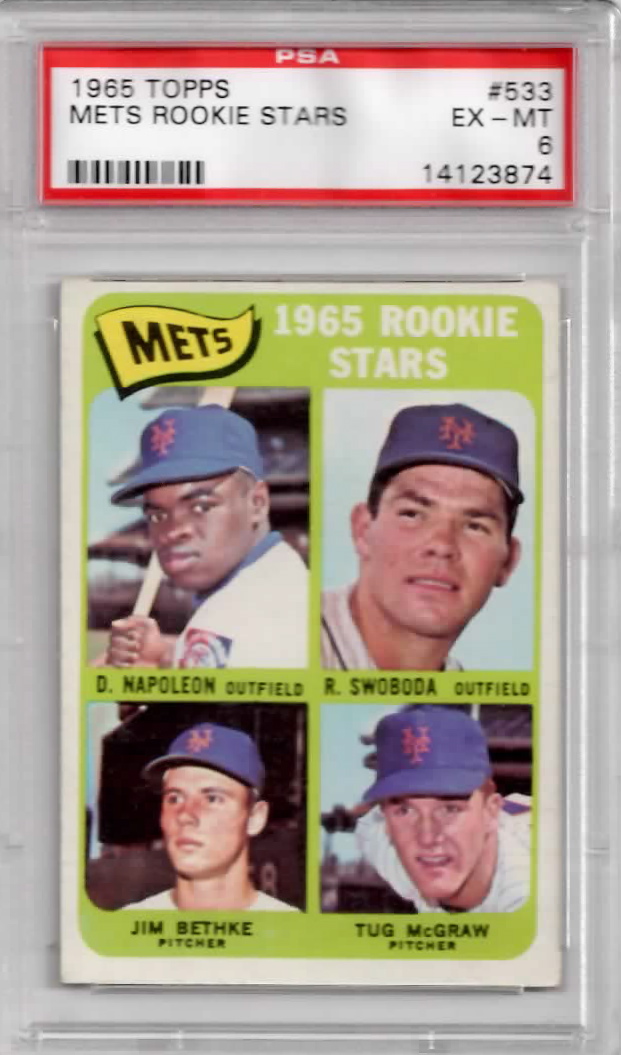
1965 TOPPS METS ROOKIE STARS #533 PSA 6


Topps could see 1969 coming from a mile away.

They knew by the mid '60s that the Mets' farm system was just bursting at the seams with talent-- so much talent that the team merited a four-player rookie card in the 1965 high-number series, a distinction that was reserved for only several other squads that year.

And sure enough, the Mets improved almost incrementally from 1965 until the championship year.

The exploits of Swoboda and McGraw are well known, but what of the other two players pictured here?

Well, Dan Napoleon logged 130 ABs between 1965 and 1966, with an anemic .162 average. As further evidence of his essential iron deficiency, he racked up a mere 4 extra base hits in his career, none of which left the yard.

This from a guy who hit 36 HRs in A ball back in 1964...

Jim Bethke holds a spot as one of the youngest players in Mets' history-- older than Kranepool and younger than Gooden, if my recall of team history is sound.

He posted thoroughly decent numbers as an 18-year-old relief pitcher in 1965, appearing in 25 games and going 2-0 with a 4.28 ERA. This turned out to be the extent of Bethke's big-league service-- he bounced around the minors before calling it quits in 1971.

Thursday, May 24, 2012

1973 TOPPS RICH CHILES #617 PSA 8
 

Here's one from the Topps' genus “scrubicus lookupicus”...

In the '60s and '70s, Topps employed a number of tactics to hedge their bets against player movement.

One favorite was the no-cap shot. These unadorned profile pictures obviated the need for any touch-up effort if a player switched teams.

You can find an abundance of no-caps in the 1969 set, where it appears that Topps just threw up their corporate hands in the face of the addition of four expansion teams that year.

The other mainstay was the under-cap pose, demonstrated so ably by this 1973 Rich Chiles. Here the player was encouraged to tilt their head upward a bit, while the Topps photographer crouched down and fired away.

While this did not flatter the physiognomy of the affected players, the advantage for Topps was that it required a minimum of airbrushing effort to represent a player with his new team.

Rich Chiles was likely wearing an Astros lid in the original photo that appears on this card, but with a thin slathering of royal blue and a couple of dabs of orange to represent the logo, voila-- instant Met.

Rich came to the Mets along with Buddy Harris in the trade that sent Tommie Agee to Houston in November of 1972. His career with the team was limited to 25 April at bats and a .120 average for the pennant-winning 1973 squad.

In the 3rd inning of an eventual 13-3 win over the Expos on April 22, he plated Ed Kranepool with a double off Steve Renko, his only RBI in the orange and blue.

Rich went on to have a couple of solid seasons as a pinch hitter and backup for the Twins in 1977 and 1978, before retiring in 1980 at the age of 30.

And here's a parting shot of trivia: Rich Chiles is the cousin of '20s Hall-of-Famer George “Highpockets” Kelly.

As it happens, back around 1973, I used to write letters to retired Hall-of-Famers seeking autographs. And this is the signed yellow plaque that Highpockets sent in response to my request...

Friday, April 13, 2012

1972 TOPPS AL-NL ROOKIES #741 PSA 8


In the vast empire that is the 1972 Topps set, this stands as one of my favorites.

It comes from the realm of the high-numbers, where the photos are sharp and dimensional and clear.

As a Mets' collector, I particularly like the way that Milner is set in the middle of this multi-player rookie card like a fine cameo brooch.

But I also love the thematic consistency of the card, with its trio of East Coast, left-handed first basemen, wielding bats while dressed in full game livery.

I tell you, I could just wander though the 1972 set forever...

Thursday, March 8, 2012

1964 TOPPS ROOKIE ALL-STAR BANQUET #11 PSA 9


I'm a sucker for oddballs.

Oddballs of all sorts, really. But here I'm referring specifically to those idiosyncratic test issues and limited-run sets that have emanated from Topps over the years.

This particular card is from the 1964 Topps Rookie All-Star Banquet set.

Back in the day, Topps would hold a ceremony each year to honor the players who were selected to their all-rookie team. You and I know these players best as the ones who received a garish gold trophy on the front of what was generally their second-year card.

Each year, Topps produced a program to accompany the ceremony, but in 1964 they decided to stick with their metier and do the program in card form.

The oversized, blank-backed cards were presented as a boxed set, and folioed with page numbers rather than card numbers. The card subjects ranged from the Topps' voting committee, to current winners, to past recipients.

This particular card-- page 11 in the set-- depicts the members of the 1962 Topps Rookie All-Star team. So each and every one of the players pictured here appeared in the 1963 set with a rookie trophy adorning their card. You could look it up, as the man once said. Here's the 1963 Al Jackson as an illustration:


The interesting thing about the 1963 trophies is that they are the only ones I can recall that actually replace a design element on the card-- standard 1963 cards have a large circle containing an inset photo.

Of course, what attracted me to this card with an intensity that led to purchase was the presence of Mr Jackson down in the lower-right corner, who made the all-rookie team on the strength of his 8-20 season for Casey's Amazins.

And as an ancillary bonus, three of the other players on the card eventually did time with the Mets as well: Ed Charles, Al Luplow, and Dean Chance.

This card, in the main, is not particularly attractive or dynamic. But it is just oddball enough to earn a place in my heart...

Thursday, February 9, 2012

1970 TOPPS METS ROOKIES #348 GAI 8


Lean in closely-- today I'm going to whisper about a curse.

It is a curse somewhat obscure in its application, but devastating nonetheless.

It is the curse of the two-player 1970 Topps rookie cards.

Five different players on these split-level cards died before they reached the age of 40.

Fortunately, the two Mets players pictured here were not affected.

Mike Jorgensen left the Mets for the Expos in April of 1972 as part of the package that brought Rusty Staub to Flushing. Mike had some productive years as a starter for Montreal, and he even boomeranged back to the Mets in the early '80s, serving largely as a lefty bat coming off the bench. Mike's career lasted for 17 seasons, and he is currently a member of the Cardinals' front-office staff.

Jesse Hudson pitched in one big-league game in his career, a two-inning mop-up stint in the nightcap of a Pirates' double-header sweep of the Mets in September, 1969. Jesse is still alive today, but he remains an elusive autograph for collectors trying to complete a set of signatures from everyone who spent time on the Mets' roster during that wondrous 1969 campaign.

Now here's a rundown of the players who were not so lucky...

Thurman Munson


The most prominent player on the list, Munson died while piloting a Cessna Citation in the summer of 1979. He was 32.

News of his death came to us in a suburban Long Island basement while we were playing Mattel Electronic Football or listening to Bat Out of Hell or doing some other 1979-type thing. We were Mets' fans, but we were crushed by the news, and his death tore the ornery heart out of the Yankees. Champions in 1977 and 1978, they would not win the Series again until 1996...

Carl Morton


To this day, Carl Morton remains the only MLB player with whom I've had a face-to-face conversation.

It happened along the third-base rail at Shea Stadium, about an hour before a 1972 Mets/Expos game. I was among a small clutch of kids waving programs at the visiting Expos' players asking for autographs, when Morton walked over.

He grabbed my program and my pen and signed his name quickly. Then with a broad grin on his face, he said, “Y'all read your bible now, son. It's a good book, y'hear?”

I muttered “Yessir,” took the program back from him, and traced over his signature with my finger. His name bisected a puffy cumulus cloud that floated over Shea in the fish-eye lens stadium photo on the program's cover.

Morton, the 1970 National League Rookie of the Year, died of a heart attack in 1983 at the age of 39.

Randy Bobb


Randy Bobb had one hit in 10 career at bats with the Cubs, a 4th inning single off Ron Reed of the Braves on August 21, 1968. Bobb was replaced by Randy Hundley in the top of the 6th of that game with the score tied at 5-5, and the Cubs went on to win 13-5, with Billy Williams driving in seven runs.

Bobb spent 1970 bouncing around AAA with the Cardinals, Brewers, and finally, the Mets. He went on to appear with Tim Foli on a 1971 Mets rookie card, but he was never again able to ascend to the majors. His career came to a close in 1973, after splitting the season with a couple of AA teams.

Randy died in 1982 at the age of 34 as a result of injuries suffered in a car accident.

Herman Hill


Hill did Randy Bobb one better and scored two career hits. However, it took him 24 at bats to do so, leaving him with a lifetime batting average of .083.

Both hits came in the same game, a 5-4 Twins victory over the Royals on June 29, 1970. Hill singled twice off Dick Drago, and came around to score both times.

Hill was traded to the Cardinals in October of 1970, and traveled to Venezuela to play winter ball that same year. He drowned while swimming near the city of Valencia, at the age of just 25.

Miguel Fuentes


Miguel Fuentes earned a September, 1969 call up with the Seattle Pilots after having a dominant campaign for the Class A Clinton Pilots. He went 8-2 for Clinton with a 1.46 ERA, pitching mostly in relief.

He showed flashes of promise with the big club, including a complete-game 5-1 victory over the White Sox. While this September 8, 1969 contest would turn out to be Miguel's only MLB win, he is also noteworthy for having thrown the final pitch in Seattle Pilots history. He worked a clean 9th inning in the team's 3-1 loss to Oakland on the final day of the 1969 season-- eventually, the Pilots became the Brewers and the franchise moved to Milwaukee to start the 1970 season.

Fuentes was shot three times in a bar fight in January of 1970, and died as a result at the age of 23.

Tuesday, December 20, 2011

1972 TOPPS TOM SEAVER BOYHOOD PHOTO #347 PSA 7, GAI 8


This week on Mets360, I covered the gloriously ludicrous 1972 Topps set in general, and the ludicrously glorious boyhood-photos subset in particular, so I won't trouble you with redundancy.

Rather, this is an entry in “We Flip 'Em So You Don't Have To.” Here's the text on the reverse of the Seaver boyhood-photo card, under the heading “Young Tom Seaver”:

“Tom graduated from Fresno High School in Fresno, California in 1962, he played baseball and basketball and was named to All-City teams in both sports. In 1964 Tom won 11, lost 2, and was named to the All-Valley Conference team. Tom attended the University of Southern California for two years majoring in Public Relations and played varsity baseball. In 1965 he won 10 and lost 2 and was named to the All-California Intercollegiate Baseball Association Second Team. A veteran of Little League and American Legion Baseball, in 1964 Tom helped lead the Alaska Goldpanners of Fairbanks to the state semi-pro title and second place in the National Baseball Congress Tournament at Wichita, Kansas. He won two without a loss in the national tournament and hit a Grand-Slammer, was named to All-Alaska and NBC All-America teams.”

You can find some more info on Seaver's stint with the Goldpanners here.

And yes, I own two of these cards, more out of absentmindedness than affection...

Friday, November 11, 2011

1967 TOPPS SANDY ALOMAR #561 PSA 8


This card is the Frick to the Fracking gorgeous Shaw/Sutherland rookie that I wrote about in the previous post, and I scored it in the selfsame $65 deal.

Near as I can tell, Sandy here is part of the only father/son pair ever to play for the Mets, along with Hall-of-Fame offspring Roberto.

Sandy didn't exactly light it up in his brief tenure with the team. In 22 ABs that year, he logged a .000 OBP-- no hits, no walks, no nothing.

Well, he did score one run, presumably as a pinch runner, so he didn't leave Flushing empty handed.

This '67 card is even kind enough to tell us in a tacked-on note that Sandy was "sent to Jacksonville" on May 23...

He went on to have a thoroughly decent career as a middle infielder for the Angels, Yankees, and Rangers, retiring in '78. He logged 1,168 hits, over 1,000 of which were singles.

And who better to write about on 11/11/11 than an inveterate singles hitter?

Friday, October 28, 2011

1967 TOPPS SHAW/SUTHERLAND #587 PSA 8


Well, would you look at that...

A couple of weeks ago, I landed one of the cards near the top of my want list, at the Chantilly show down here in NOVA.

The amount and quality of vintage graded material seems to have increased at this show over the course of the last couple of years.

You've always had your big dogs with their big dollar cards at the front of the hall, but I'm finding a better selection at some of the smaller tables along the side streets and alleyways.

And as much as I hate to sully this blog with price-taggery, I also have to report that I was very happy with the deal I got on this card.

The particular dealer from whom I purchased it had a nice array of '66 and '67 high numbers, many in PSA 8 or equivalent condition. The slabs were priced prominently and clearly with a round white sticker.

My eyes fixed immediately on the Shaw/Sutherland and another '67 high number, each of which carried a $40 price tag. Now, having been a longtime eBay groupie for the Shaw/Sutherland specifically, I was thrilled-- more often than not, specimens in this condition will close in the $80-$100 range.

So I presented both cards to the person manning the table, and asked “What can you do on these?”

He was apparently just watching the booth while the real dealer was off making a deal with someone else, so he walked away. “I'll be right back.”

A couple of minutes later, he rounded a corner, and our eyes met. “$65 for both?” he asked.

Well, needless to say, I quick-drew my wallet and handed him $70. He returned the cards and a $5 bill.

And I put this up for auction the very next day...

Monday, October 10, 2011

1975 HOSTESS BUD HARRELSON #45 PSA 10


Please sir, can I have some more?

Another round of food, glorious food for you this week.

Back in the mid '70s, Hostess began printing three-card strips on the box bottoms of their various snack cakes. So if you took home some tasty Twinkies, Ho-Hos, or cream-filled CupCakes, you might be lucky enough to score a panel of, say, Garry Maddox/Carlos May/Bud Harrelson.

And if you were anything like me, your tween scissor skills were kind of erratic, and you probably ended up slicing a long gash through Bud's primo porn-star stache.

Fortunately for posterity, the card-collecting hobby was well-formed enough at this point that folks would break down the boxes and save the package flats intact.

Then at some future date, someone would cut out singles with laser-like precision, leaving us with gem-mint 10 examples such as this one.

Topps supplied the photos for these cards, but it seems pretty clear that they mostly went with their second-tier portrait shots, like this one of Bud pretending he's a left-handed hitter.

The card backs contain a five-year run of stats, a basic biography, and full player names. I'm looking at you, Derrel McKinley Harrelson.

All in all, the set is more gruel than foie gras, but we hungry orphans of the '70s knew better than to be picky, and I'm happy to have it in my collection today...

Friday, September 16, 2011

1963 JELL-O GIL HODGES #193 SGC 60


You see, we had the box of the Jell-O and there on the bottom of the box we had the ballplayers and the frazzle snazzle and the bleeble blabble...

OK, OK, I'll turn off the Cosbyizer.

Continuing the theme of Gil Hodges in snack form, this is a 1963 Jell-O card.

The picture on the front is one of the best I've ever seen of Gil as a Mets' player, and the text makes plain why it's a travesty that he is not in the Hall of Fame. To wit:

“Gil holds two NL records-- for most HRs by a right-handed batter (370) and for most grand slams (14). He is tied for most consecutive seasons (11) with 20 or more HRs... In 1957 he received the Gold Glove Award as outstanding major league fielder at 1B and the NL Gold Glove Award for 1st baseman in 1958-59.”

So power hitting at then-historical levels, fielding prowess, not to mention a leadership role on the 1955 Dodgers club that beat the Yankees is not enough to garner more than 63.4% of the vote? I mean, Orlando Cepeda and Tony Perez rate, but not Gil?

Even this card ends up giving Gil the business. Right there at the bottom of the text box is a small line that reads as follows:

“Note: Gil had no Grand Slams in 1962.”

What the what? Who in the wide world of sports thought it was necessary to insert this little finger-wagging nyah-nyah-nyah-nyah of a note to this card?

Was it you, Trebek?

Monday, August 22, 2011

1971 TOPPS SLICK PROOF GARY GENTRY #741 BVG 4.5


Adventures in grading, part 2.

To see the grade, you'd think I really spit the bit on this one. But as far as I can tell, there are no obvious issues with the card. The centering is good, the corners are acceptable, and I don't see any apparent creases.

I suspect that what knocked this card down was its surface. The good folks at Beckett probably didn't know what to make of all that slickness...

I bought this Gentry several years ago in a Topps Vault auction, where it was classified as a “slick proof.” It was one of a run of 1971 high numbers to which Topps had applied a layer of some sort of varnish. I imagine that this was an early test for the type of coating that would enter commercial production with later issues such as the 1983 all-star glossy send-in set and the 1984 “tiffany.”

The card has a complete back, which leads me to wonder exactly how Topps executed the test. Did they coat a finished sheet of cards and then cut them as well? Or was it a piece-based process, where they just pulled some individual cards from the high-number series and brushed on a layer of gloss?

It's a mystery wrapped in a riddle wrapped in an enigma wrapped in a Beckett 4.5 slab, and I love this card for all that...


Friday, August 5, 2011

THE BIG '80s, PLUS

A bit of a change of pace here.

Last week, I picked up some older unopened packs, and shot a pack-rip video.

Now, I give you fair warning: this thing is pretty epic. It's about as long as your average sitcom.

Hell, at the 12 minute mark, Mr Furley bursts through the door and we have a wacky misunderstanding over a Rusty Kuntz card.

Epic. Again, you've been warned.

Friday, July 15, 2011

1964 TOPPS STAND-UPS AL JACKSON #36 BVG 7


Adventures in grading, part 1.

There's an excellent chance that this is the only graded card in my collection that I've actually held in my hands in raw form.

You see, until recently, I'd never graded any cards of my own. The whole process just seemed too Byzantine and expensive. Fill out this form, fill out that form, join this club, pay for grading, pay for return shipping...

So my stance has been, “Thanks, but if it's all the same with you, major grading companies, I think I'll just buy my PSA 8 1972 Don Hahns on eBay for $6 or $7 shipped.”

But then I received a Beckett coupon for two free submissions, and I figured I'd take the plunge. I debated long and hard regarding the two candidate cards.

I considered sending in a 2010 Bowman Strasburg purple refractor numbered out of 999. It's a purty card, sharp and well centered-- before Stras went down, I was offered $100 for it out at the Chantilly show, but I declined.

I know, I know...

I also thought about pulling a couple of cards from my 1970 set (which, by the way, is almost complete now-- down to just Rose and Frank Robinson). I have a passable Ryan card that I thought might garner a 6, but I kind of like seeing it there in the sheets in sequence, tucked between Ed Brinkman and the Pilots team.

Finally, I identified two cards, one of which was this 1964 Topps Stand-Ups Al Jackson.

I bought this card in my early days of graded collecting, before I knew about all of the rogue, fly-by-night operations that would grade counterfeit/trimmed cards, and/or severely overgrade. So once upon a time, I was thrilled to win this FGA 9 for $10, not realizing it was essentially a Magnetbox.

One evening, I broke out my toolbox and liberated Al Jackson from the surprisingly sturdy FGA case. My loupe was back at the office, but to my eyes, the card looked nice enough. I turned it over several times in my hands, being extra careful not to pop the die cut, and then placed it in a penny sleeve and a rigid plastic holder, ready for the mail.

About a month later, I received an e-mail from Beckett letting me know that my order was complete, and I was pleased to see the card get a BVG 7.

And I have to say I like it all the more for having once held it briefly in my hands...

Wednesday, June 29, 2011

1954 DAN-DEE GIL HODGES PSA 4


My card collection is very ordinary.

No high-dollar, high-grade specimens meant to shock and awe, or win any ribbons at the county fair.

It's mostly vintage Mets, which by definition means it's mostly commons.

I'm happy with 7s and 8s, and will brook the occasional lower grade for a Seaver or a scarcity.

The majority of my cards are not special in any way, shape, or form.

But I'm going to crow about this one a bit...

The 1954 Dan-Dee set was distributed one card at a time in bags of Dan-Dee potato chips. The cards were unwrapped, and sat in their bags marinating in “hylo-ized” goodness.

And no, I don't have any idea what “hylo-ized” means, but it must have been very popular in the mid '50s, since the term is featured both on the bag and on the backs of the cards. Perhaps the process of hylo-ization somehow produced the “radiant energy” that is claimed on the front of the bag.


I don't know about the chips, but “radiant energy” is as good a description as any for this Gil Hodges card. It is a grease-stained, rough-edged, soft-cornered force of nature.

Gil is featured in a casual and engaging pose, his Brooklyn Dodgers' hat bisecting a lowering sky, and his Adam's apple acting as a perfectly centered focal point. The grease stains that helped earn this particular version a PSA 4 add a beautiful element of natural toning to the card, both on the obverse and reverse.

It really is an extraordinary card...

Thursday, June 16, 2011

1985 TOPPS MINI ED WHITSON #762 PSA 9


OK, the fact that I own a PSA 9 Ed Whitson card might seem perverse at first blush.

You might think that I derive from it a shameful joy in remembering that long ago time when the Mets ruled New York. When Ed Whitson became a symbol of every boondoggle Yankees' free-agent signing, reviled in his own house and bar-fighting with his unstable manager...

Ah, good times.

But actually, I'm more interested in the card because it commemorates another Topps mini-card boondoggle.

Topps had gone down this road ten years prior, no doubt in an effort to see if it could reduce paper costs. The 1975 cards were produced in fairly large quantities and distributed in different regions (Michigan and California, primarily) in wax, cello, and rack packs.

These 1985 minis were a bit larger than their 1975 counterparts, and only 132 cards out of the 792 cards in the regular set were produced in this format. The cards were never released officially, but they have trickled into the hobby market over the years and are not hen's-teeth rare. They are cute but not cloying, and I highly recommend adding at least one to your collection if you have any affinity for the 1985 Topps set.

And Eddie Whitson? Well, from late June to September of that nightmarish 1985 season, he actually went 9-1 with a 2.27 ERA. But then came the aforementioned battle with Billy Martin, and a rough start in 1986 sealed his fate in New York. He was dealt back to the Padres, where he eventually recovered and managed to put together a few thoroughly decent valedictory seasons before he retired.